Showing posts with label Gottesdienst. Show all posts

Wednesday, August 2, 2017

Have you...

seen The Video?

The buttons were going like hotcakes at the Institute on Liturgy, Preaching and Church Music last week.  Even if you can't get your hands on one of our buttons, you can click, watch...and share The Video!


Thursday, September 15, 2016

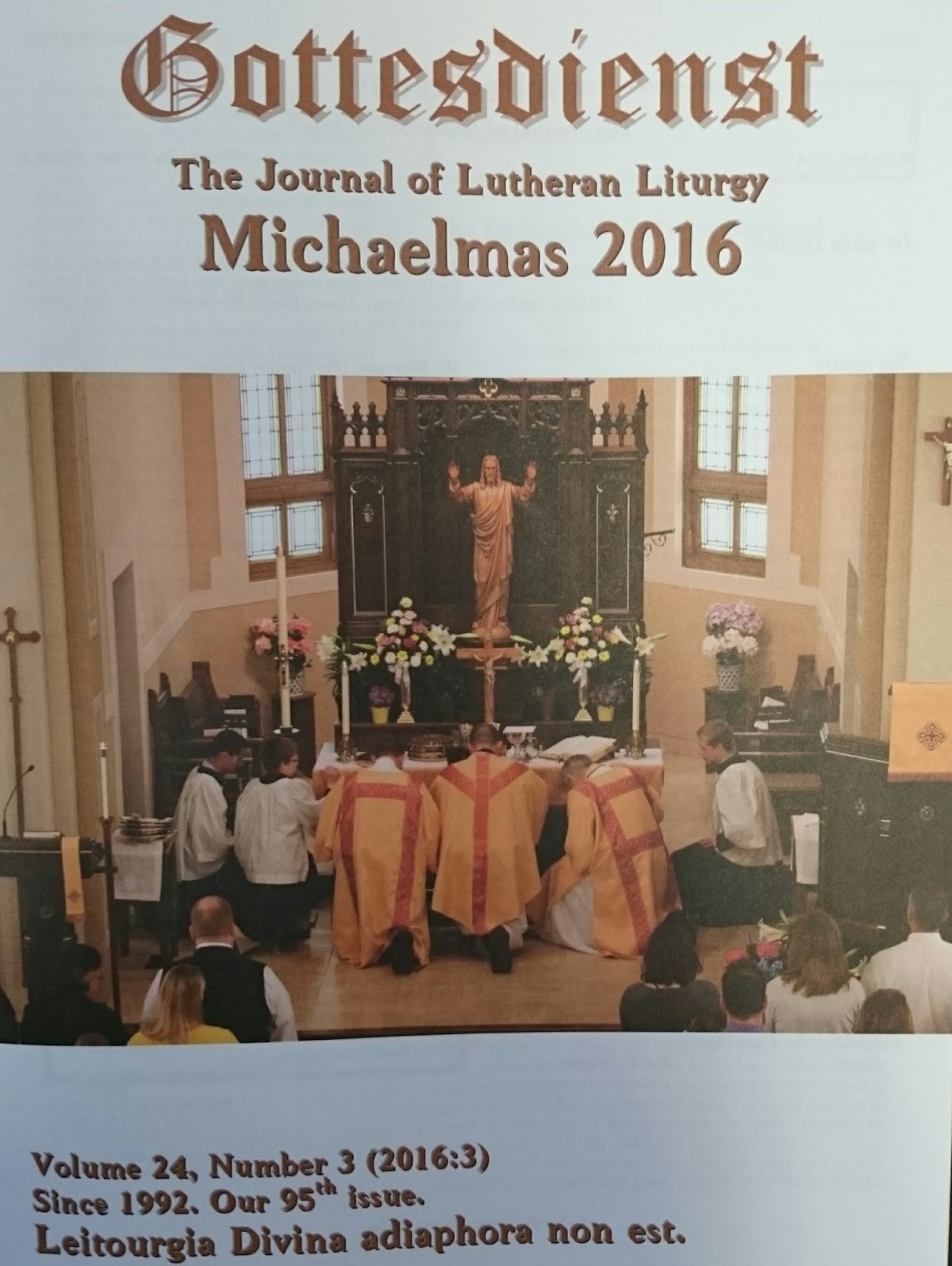
Gottesdienst

. . . is out of the barn! Coming to a mailbox near you, unless you have not subscribed. In which case, here's how.

Tuesday, May 12, 2015

Conference: Gottesdienst - St. Louis


A one-day conference: Marriages and Weddings

Tuesday, June 30th, 2015

St. Paul Lutheran Church (Hamel)
6969 W. Frontage Rd.
Worden, IL  62097

Featuring from among our editors

Rev. Fr. Larry Beane, MDiv
Rev. Fr. David H. Petersen, MDiv, STM
Rev. Fr. Heath R. Curtis, MA, MDiv
Rev. Fr. Jason Braaten, MDiv
Rev. Fr. Burnell F. Eckardt Jr., MDiv, STM, PhD
Rev. Fr. Mark Braden, MDiv, STM


Schedule

8:30 - 9:00 am - Registration / Coffee & Donuts
Holy Absolution available

9:00 am - Matins
9:40 am - Welcome
9:45-10:30 am - "The Two Shall Become One": A Theology of Marriage
   Fr. Larry Beane, Online and Departmental Editor
10:45 am - Holy Mass

12:00 pm - Lunch

1:00 - 1:45 pm - "What God Hath Joined Together": A Theology of Weddings
   Fr. David Petersen, Departmental Editor
2:00 - 2:45 pm - "On the Dissolution of Marriges"
   Fr. Heath Curtis, Online Editor
3:00 pm - Panel Discussion - The Gottesdienst editors
3:45 pm - Vespers
4:30 pm - Gemütlichkeit


Lodging - On your own.  Recommended:

The Innkeeper Motel,
401 E. State St., Hamel, IL  62046
(618) 633-2111  www.innkeeperinn.com


Registration

$25 (Payable to Gottesdienst)

You may email the following info to b.f.eckardt@gmail.com with "Gottesdienst" in the subject line, and you may pay the registration fee in advance, or when you arrive.

Title & Name
Parish
Email
Address
City, State, Zip
Phone

Your sectional preferences (please select two):
   Pre-Marital 'Counseling'
   Divorce & Remarriage
   Planning the Wedding
   Having Children and Raising Them

Babysitting requested?


Wednesday, March 26, 2014

Empty Barn!

The proverbial horse has bolted, and the barn is empty! That is, the current issue is at the Post Office, and coming soon to a mailbox near you.  Assuming, that is, that you are a subscriber.  (Yes, there is a print edition.  Subscribe now if you didn't know that, or if, for some other unfathomable reason, you aren't already).


In this issue: 

Sermons
Chad D. Kendall Eric R. Andrae and Bo H. Giertz Andrae and Giertz Larry L. Beane II David H. Peter sen


Commentary on the War David H. Petersen
 Learning from Chrysostom   
Liturgical Observer Burnell F. EckardtJr.
Pardon the Interruption        
Casual Sundays
Who Says the Our Father?
Homer Nods
Sabre of Boldness Jonathan E. Shaw
Justifying Sanctification       
Michael Brockman Is 2014 Sabre Bearer
Taking Pains Mark P. Braden
Rogation Days, Ember Days 
Poem
The Apostolic Faith   Kathryn Ann Hill 
Musing on the Mysteries Karl F. Fabrizius
And He Died Genesis 5:5-27     
                            

Call For Sermons!


By Larry Beane

One of the hallmarks of our Lutheran tradition - especially within our confessional and liturgical tradition - is the strength of our preaching.  It is always a great privilege for me, as the sermons editor of Gottesdienst, to review and ponder sermons from my brethren in the Holy Office.

We all have our favorite go-to preachers that we can count on to proclaim Christ crucified, to thunder with the law, and to soothe with the gospel.  We also have a diversity of styles and approaches to the homiletical enterprise and how a given text is treated.  Our Lutheran preaching is indeed a treasure trove, and the quarterly sermons published in Gottesdienst are a delight to our readers.

Of course, every year, our seminaries release more faithful men to do battle against sin, death, and the devil, and as preachers grow in stature and experience, their preaching improves and grows.

I know there are sermons out there that should be published in Gottesdienst, to edify pastors and laypeople alike, to assist pastors young and old in freshening up their own preaching, and in illustrating with clarity that good liturgy is not only about proper rubrics and ritual, but also in faithful proclamation of the Word.

So, if you know of a particular sermon or preacher you would like to see in our print journal, send me an e-mail at pastorbeane (at) gmail  [dot] com.

The only catch is that we run roughly a quarter ahead of time.  Even though our current attention is on Lent, Passiontide, and Eastertide, for publication, right now I am looking for sermons for our Trinity issue.  So please point me to sermons from the early Trinity season (before Michaelmas).  Also, as Sts. Peter and Paul falls on a Sunday this year, please consider sending me a sermon for that Sunday as well.

Getting published in Gottesdienst is even better than being on the cover of The Rolling Stone. We'll even send you three copies for your mother - or your fan club.  

Wednesday, March 19, 2014

Gottesdienst Chicago!

Coming up again this May!

A one-day conference: “Justification and the Sacrament”  — with special guest speaker Rev. Rolf Preus

Tuesday, May 20th 
Gloria Dei Lutheran Church
5259 S. Major Ave
ChicagoIL 60638

Also featuring banter and discussion from among our editors:

Rev. Fr. Larry Beane, MDiv; Rev. Fr. Jason Braaten, MDiv; Rev. Fr. Mark Braden, STM; Rev. Fr. Burnell F. Eckardt Jr., STM, PhD; Rev. Fr. D. Richard Stuckwisch Jr., PhD; Rev. Fr. David H. Petersen, MDiv


Schedule:


8:30-9:00 am  Registration/Coffee, donuts/
Holy Absolution available
9:00 am  Matins
9:40 am  Welcome
9:45-10:45 am
Justification and the Sacrament,
part one  -- Rev. Preus
11:00 am  Holy Mass
12:15 pm  Lunch (provided)
1:30 – 2:30 pm
Justification and the Sacrament,
part two -- Rev. Preus
2:30 – 3:30 pm
Panel Discussion
Response from the editors
3:30 pm  Vespers
4:00 pm  Gemütlichkeit


Lodging on your own.  
Recommended:  Hampton Inn $169. 6540 S Cicero Ave, Bedford Park, IL. (708) 496-1900 ‎www.hamptoninn.hilton.comChicago Marriott Midway $219.  6520 S Cicero Ave, Chicago, IL. (708) 594-5500 ‎www.marriott.com. Carlton Inn Midway $109. 4944 S Archer Ave, Chicago, IL. (773) 582-0900.www.carltoninnmidway.com. Holiday Inn Express Hotel & Suites $171. 6500 S Cicero Ave, Chicago, IL. (708) 458-0202. www.hiexpress.com. Hilton Garden Inn $239. 6530 S Cicero Ave, Bedford Park, IL. (708) 496-2700.www.hiltongardeninn.hilton.com. Courtyard $199. 6610 S Cicero Ave, Bedford Park, IL. (708) 563-0200.www.midwayhotelcenter.com. Sleep Inn $159. 6650 S Cicero Ave, Bedford Park, IL. (708) 594-0001 ‎www.sleepinn.com. Holiday Inn $180. 6624 S Cicero Ave, Chicago, IL. (708) 563-6490 ‎www.holidayinn.com.

Registration: $25 (Payable to Gottesdienst. Email the following info to  b.f.eckardt@gmail.com with “Gottesdienst Chicago” in  the subject line).  You may pay the registration fee when you arrive.

Registration info requested:

Your name
Your title
Your parish
Your address, city, state, ZIP
Your phone
Your email

Friday, April 26, 2013

Call for Sermons!

By Larry Beane

As I mentioned last fall, I am the sermons editor of the print journal (to which you must subscribe in order to be sanctified, as Gerhard said so long ago - I'll leave the citation to Fr. Curtis), and I am always on the lookout for good homiletical material to publish in Gottesdienst.

The next issue we will be working on is the Michaelmas issue.  Michaelmas is the Feast of St. Michael the Archangel (September 29), and it breaks up the post-Trinity season into two parts - which works well for a quarterly journal.

So if you are a pastor and have a gem of a sermon that was preached in the latter half of Trinity/Pentecost - after Michaelmas, or if you have heard or read a sermon that you think would be of benefit to our readers, please send it to me at larrybeane@gmail.com as soon as possible.

If you have other sermons from different times of the church year, I would also be more than happy to review them and hold them until the appropriate season.

And thank you, dear readers, dear brothers and sisters in Christ, dear confessors and defenders of the faith! Thank you for your prayers, your kind words of encouragement, and for reading and supporting Gottesdienst and for courageously defending the liturgical proclamation of the Gospel of Christ crucified unto the forgiveness of sins.  Your defense of the Evangelical Catholic liturgical tradition and its preaching, catechesis, and confession today will serve generations yet unborn.


Thursday, September 6, 2012

Call for Sermons!

Proof that not all Lutheran preachers are German
By Larry Beane

Dear Gottesreaders:

If you're like me, the four times a year when the print edition of Gottesdienst comes out are red-letter days.

Like eating Oreos (which I don't do anymore having gone primal), we all have different styles of consumption.  Some nibble meticulously around the edges, while others dive devil-may-care right into the scary white industrial "creme" with the exposed incisors.  As for me, I always read Eckardt first.  I am a "good company man" after all.  I blame Dave, whom I read right after Father General.

I know a lot of people really do enjoy the sermons published in Gottesdienst.  I do too, which is good, because I'm the sermons editor.  I am always on the lookout for sermons for each issue.  I need them about a quarter ahead of time.  So in other words, we are already putting together the Advent/Christmas issue.  And so I am looking for sermons especially from that part of the church year for the next issue - but I do collect sermons year-round for consideration and hold onto them.

So, what constitutes a sermon that graces the pages of Gottesdienst?  Well, personally, I like good sermons.  I don't like bad sermons.  Other than that, there really are no rules.  I suppose the sermons ought to be preached by real Lutheran pastors - pre- and post-reformation.  And they should reflect a real biblical text.  And they ought to be germane (which has nothing to do with being northern European) to the season of the issue of Gottesdienst in which they appear.  

We all have our favorite preachers - many of whom have appeared in Gottesdienst over the last 20 years.  There are some real go-to men that make my job of finding quality sermons easier.  But by the same token, there are a lot of outstanding preachers in the Lutheran world, many of whom are unpublished.  And it's encouraging to read the homiletical works of some newer guys - especially given the renaissance of sacramental theology and genuinely Lutheran preaching that we seem to be enjoying at this point in our history.

So in the spirit of J. Jonah Jameson: "Get me some sermons!"  Good ones.

If you are a pastor and have preached a sermon that you think would be valuable for our readership, this is no time to be modest.  Soli Deo gloria!  Pastors and lay people benefit from the comfort afforded in these sermons, and they also serve as helps for pastors to continue growing as preachers themselves.  It is part of your vocation to be a pastor of the Church.  If you are a layman (of either sex) and your pastor has hit a home run, please feel free to get a copy from him (or lift it from his website) and send it to me at larrybeane@gmail.com.  I always check with the preacher before submitting any sermon to the Gottesocracy for consideration.

And if you know of solid Lutheran preachers who post their sermons on blogs or other sites, please feel free to pass this information along as well.  And if you are fiddling around with your smartphone during the sermon, just tell the pastor you are texting the sermons editor of Gottesdienst that he needs to get a copy of this one.  That should get you out of the dog house.

Preaching is a matter of life and death, a means of grace, and a mystical encounter with Christ Himself in His most holy Word proclaimed by His called ministers.  Preaching has always enjoyed a place of high honor within the Lutheran liturgical tradition, and is naturally a focal point of Gottesdienst and Gottesdienst.  Preaching is one area where, in spite of our many problems and struggles, the churches of the Augsburg Confession shine with the dazzling light of Christ.

Friday, May 4, 2012

Insisting on Adiaphora (or Not)

We do not insist on adiaphora.  That is to say, we do not insist upon what God has not required; nor do we forbid what God has not prohibited.  We are, after all, called "Gottesdienst Online," not "Adiaphora Online."  We are concerned with God's Service, not with any human pretense or presumption.  And, besides all that, as editors of a blog, we are not anyone's bishop; leastwise not here.  That's not who we are, nor what we do.

To be sure, we do advocate and urge some adiaphora over other alternatives, because, among the many things that God has left free, some practices are better and stronger than others.  We have our preferences, no doubt, and we also have our reasons for preferring some practices over others.  It is also the case that we editors of Gottesdienst do not agree among ourselves on every point; in part because different contexts and different circumstances suggest different approaches, and in part because we are different people with different gifts.  Sometimes, too, it happens that one or the other of us will change his mind.  For all of these reasons and more, we cherish the freedom for which Christ has set us free, because it is the freedom to repent, the freedom to learn and grow, and the freedom to serve and care for the Church on earth.

What God has left free, that is, what He has neither commanded nor forbidden, remains free and clear before Him.  We do not presume otherwise.  Such freedom belongs to the righteousness of faith in Christ, and it is a most precious gift and treasure of His Gospel.  To insist upon any work or sacrifice of the Law, as though by it to obtain the forgiveness of sins, justification and salvation, is flat-out false doctrine.  All the more so, then, to insist upon some adiaphorous practice as though it were necessary for salvation is surely twisted and wicked.  So, too, the requirement that something God has left free must either be done or not done, as though the power and efficacy of the Gospel itself depended upon it, is pernicious and quite wrong.  We dassn't do that.  And we don't.

Now, then, the righteousness of love for the neighbor, and of good order, peace, and harmony within family, church, and state, is another matter.  There the Law must do its duty to serve and protect in the midst of sin and death.  Not only because we live, for now, in a fallen world, but also because we live, by God's grace, in His well-ordered creation.  Although the Lord holds all things in His hand, and He governs all things by His Word, He has given man dominion over the works of His hands, as demonstrated, for example, by Adam's naming of all the animals.  And whereas God has left so many of the details and specifics of life on earth free and unscripted, He has given fathers of various kinds to exercise wisdom and judgment, and so also to establish rules, for the benefit of those under their paternal care.  Fathers are not free to contradict or disobey the Word of the Lord, but under His authority they are free to establish and enforce rules of conduct according to the particular context and circumstances of their own "family," whether that be a single household, a village or city, a state or the entire country.

St. Paul relates the paternal management of household and family to the work of pastors and bishops, who are called and ordained to be spiritual fathers of the household and family of God (1 Timothy 3:4-5).  That apostolic word informs and supports our Lutheran confession that "it is lawful for bishops, or pastors, to make ordinances so that things will be done orderly in the Church" (AC XXVIII.53).

As spiritual fathers, pastors and bishops not only can, but should make decisions and even insist upon particular practices that God has not universally commanded or forbidden; certainly not as though to "merit grace or make satisfaction for sins" (AC XXVIII.54), but for the benefit of the Church on earth in her life together.  Some of those decisions will be unique to each congregation, and that is the nature of pastoral care.  But many others will also connect and relate to the larger fellowship of the Church.  Which means that pastors ought to act in consultation and harmony with one another in caring for, leading and guiding their respective parishes.  Bishops with fraternal oversight of the pastors in their own proximity, "diligently joined in unity of doctrine, faith, sacraments, prayer, works of love, and such" (SA II.IV.9), may also serve to promote the harmony of the Church's life together.

The truth is, because God has left so many of the specific details "free," there must be some insistence upon adiaphora if there is to be any sort of "community."  Rules of conduct held in common within each particular household and family, as well as broader rules of mutual engagement within the larger fellowship of the Church, enable brothers and sisters in Christ, and brother pastors and sister congregations, to live and work together in faith, hope, and charity, each person and each parish according to his, her, or its particular place. The freedom of faith in the Gospel does not prohibit but permits and makes possible such rules or "rubrics" of familial life.  The Church on earth necessarily makes these decisions, as she always has and always will, in one way or another.  Some forms of ecclesiastical polity and governance work better than others, and that may vary according to time and place, but there must be some such polity and governance in place.  Ideally, at ground level, the pastors will care for their own respective congregations in the way that responsible, God-fearing and law-abiding fathers care for their own families, within the context of the communities in which they live.

The Gottesdienst editors, as pastors, do engage in such paternal care of their respective congregations.  But, collectively, as "Gottesdienst Online," we do not insist on adiaphora.  What we do is to advocate and urge the use of godly ceremonies, because such practices contribute to the catechesis and confession of the Word of Christ; they honor the means of grace and the ministry of the Gospel; and they adorn the Church with beauty and glory.  Along with that, we also defend the freedom to do that which is truly free in faith and love.

What we insist upon is the doing of what God has commanded, and the not doing of what God has forbidden.  Thus, along with our Lutheran Confessions, we deplore and decry frivolity, irreverence, anarchy and chaos, spectacles of worldly entertainment, and whatever else contradicts or undermines the Word of Christ (FC SD X.1, 7, 9).  Such things are not adiaphora, but are contrary to the Word of God, and are thus forbidden by God.  Permitting such practices to continue without comment within the fellowship of the Church would be irresponsible and wrong.  So we speak in opposition to frivolity and irreverence, even as we defend and recommend the practice of godly ceremonies that promote dignity and reverence.

Wednesday, March 14, 2012

To Glorify Christ by Adorning His Bride with the Beauty of His Gospel

All our performance, be it little or much, has in the past had no other intention and has no other now, than to honor the creative words of our most holy Consecrator in the Sacrament of the Altar. We poor people of [Gottesdienst] desire to dedicate all our entire work as a trifling but ever-blooming wreath of gratitude and praise to His Altar (Wilhelm Löhe).

These words describe my own conviction and central concern, which is, I believe, one that I hold in common with my fellow editors. I don't know how I could summarize my intentions any more pointedly and precisely than Löhe did; although, if his great work in Neuendettelsau was a "trifling," then I have not yet begun to contribute anything. I am here by the kind consideration and patient tolerance of my brothers in Christ, who have carried the weight of this blog, and me along with it, for the past several years now. I count it a privilege to be numbered among them, because what we are about is worthwhile; because Christ and His gifts are worthy of reverent attention, and His dear Bride ought to be treated like a lady.

As pastors of the Lord's Church, we are called to preach and administer His Gospel within our own respective congregations, and so to serve and care for His people with His means of grace. That is so much the focus and priority of the pastoral office, and such a consuming responsibility, it is tempting for any pastor to keep his head down, to put his blinders on, and to ignore the rest of the Church. Indeed, it is quite right that we should not intrude upon another man's office, nor interfere with another man's servant. Yet, we are not free agents or independent contractors, and the office that we serve did not originate with any one of us. We are recipients and ministers of a sacred tradition, which has come down to us from the Father through His incarnate Son, our Lord Jesus Christ, by the way of His Apostles and Prophets, and pastors and teachers before us. So, too, the one, holy, catholic and apostolic Church that we are called to serve within our respective congregations is a holy fellowship in the Gospel across all times and places.

We are heirs of the faithful fathers who have gone before us, and we are all brothers in Christ with those who serve His Church in this generation. That is not incidental but integral to who we are and what we are called to do. We belong to one another, as we belong to one Lord. Not only that, but, as we are entrusted with a stewardship of the Mysteries of God, so are we to hand over the sacred tradition that we have received to faithful men who will come after us.

The heart and center of that sacred tradition is the Sacrament of the Altar. St. Paul makes that clear in 1 Corinthians 11, but it is already given by our Lord Jesus Christ when He says, "Do This in remembrance of Me." Of course, it isn't handed over on a blog, nor in a journal; no more than it is carried out in the offices of the IC, the stockrooms of CPH, or the classrooms of a seminary. It is not even in the Holy Gospels or Epistles that the Sacrament is handed over and received, but in the life of the Church, in the administration of the Holy Communion. By the grace of God, that is happening all over the world, from the rising of the sun to its going down, on the basis of the Word of Christ, recorded in the apostolic Scriptures. Thence we know the rubrics, rites and ceremonies established by the Lord, the words and actions prescribed by His "Do This." But the actual tradition of the Sacrament itself is at the Altar. We do not presume to hand it over here.

What we are doing here, through a mutual conversation of brethren, is serving and supporting one another in the faithful handing over of the Sacrament with all that it entails. Doing so on a blog doesn't take the place of doing so in person, whether at official gatherings, around tables, or in confession. But this sort of forum is a tremendous blessing. Like any of God's good gifts, it can be misused and abused in evil ways that hurt or destroy the neighbor. It can also be idolized or demonized, thereby either worshiping the creature instead of the Creator, or else despising what ought to be received from the Lord's hand with thanksgiving. But as a means of communication, as a medium of words, it facilitates discussion and debate, whereby we sharpen each other and learn from each other. It broadens the table and furthers the conversation. I am so very grateful for that, and I am convinced that many others are, too.

With this blog, with "Gottesdienst Online," we are chiefly aiming to serve and support what happens not here but in the parish: the right administration of the Sacrament in accordance with the Gospel. As simple as its fundamental basics are — bread and wine, the Words of Christ, a pastor to administer, and communicants to eat and drink — this awe-full Mystery is the most profound thing in all of creation. Not just "a thing" unto itself, but the very beating heart of the Church, on earth as it is in heaven. It belongs to a larger living context, which it also defines. And, because it is the most precious thing of all, it is subject to constant attack by the devil, the world, and our own sinful flesh. We dare not take it lightly or for granted, and we dare not rely upon our own wisdom, ingenuity and competence for the right administration of this Holy Sacrament.

To address the right administration of the Sacrament calls for a lively discussion of weighty and significant matters. The preaching of repentance for the forgiveness of sins, and the ongoing catechesis of the Word of Christ, both belong to the right administration of the Sacrament. So it is that Gottesdienst is concerned with liturgical and sacramental preaching; that is to say, not so much a preaching about the Liturgy and Sacraments, but that preaching which is an integral and necessary part of the Liturgy, preaching which is itself a means of grace and forgiveness of sins. And Gottesdienst is concerned with faithful catechesis, which goes beyond academic pedagogy to the way of life in Christ, which is rooted in Holy Baptism. Such catechesis brings sinners to and from the waters of the font, to and from the Body and Blood of Christ, in repentant faith, as Christian disciples.

As editors, we are not simply discussing and dispensing whatever wisdom we may already have gained along the way, but we are truly searching to become more faithful preachers and catechists, ourselves. For the preaching of the Gospel and the catechesis of Christ Jesus are the glory of His holy Name and the most beautiful adornment of His Church.

The right administration of the Sacrament in accordance with the Gospel is the height of pastoral care, which also requires and calls for an ongoing context of pastoral care. That is what faithful preaching and catechesis properly are, but the care of souls proceeds from there, from the font, the pulpit, and the Altar, into the lives of the people. It searches out the lost and wandering sheep, in order to rescue and bring it home rejoicing, to the Feast at the Good Shepherd's Table. So Gottesdienst is concerned with pastoral care in all of the various ways and means by which it is exercised, each of which is catechesis and a preaching of repentance for the forgiveness of sins. It includes the practice of closed Communion and church discipline, and especially the teaching and practice of Individual Confession & Holy Absolution. It means that even the little children are catechized, cared for, and communed as Christian disciples of Jesus. It means that hymns are carefully chosen with the same consideration that accompanies the writing of faithful sermons.

Ceremonies, too, are a means of pastoral care in the administration of the Sacrament, especially because they are such a powerful means of catechesis. Ceremonies teach, as our Confessions indicate. They confess with the body what we believe with the heart and profess with our lips. Although our hearts are never as faithful and sincere as they ought to be, godly ceremonies, like orthodox words, remain objectively and outwardly true. As a kiss, a hug, a bouquet of flowers or a box of chocolates express a man's love for his wife, so do the sign of the cross, beautiful vestments, and bending the knee confess our love for Christ and His Gospel. Necessary? No. Beneficial? Yes. For ceremonies like these embody our faith, in such a way that little children and adults are able to recognize and grasp the significance of what is happening.

In any case, it is impossible to administer the Sacrament of the Altar without ceremonies of some kind, because we are bodily creatures living in space and time, and because the Sacrament itself is an external ceremony. Therefore, it isn't a question of whether or not to have ceremonies, but only a question of which ceremonies will best confess the truth of the Sacrament.

Consequently, Gottesdienst is concerned with advocating ceremonies that are worthy of the Gospel. We cannot add anything to the Gospel, but surely we should honor it with our actions as we administer and receive the Sacrament. To bend the knee at the Name of Jesus, for example, confesses that He is our Lord, and that our bodies are in the presence of His Body.

For myself, I find that the deliberate use of ceremonies helps to curb the frailties of my own fallen flesh, and to focus my heart and mind on what I am given to do. On any given Lord's Day, whether I am weary or worried, depressed or distracted, this discipline of my flesh in the conduct of the Divine Service pulls me back to the Mysteries of God. It reminds me, and it demonstrates for the congregation, the seriousness of what we are gathered for.

There's frankly a lot to consider and manage in the administration of the Sacrament, which is easier to grasp theoretically than it is to practice in the cut and thrust of parish life. The pastor is a finite mortal creature with temptations and sins of his own, with heartaches and hurts to contend with. He is sent with the Gospel of Christ to love and serve people who may or may not appreciate his efforts. Introducing a better practice in the conduct of the Liturgy may be met with apathy, resistance, or outright hostility.

Where does one begin? How does one proceed? These are not easy questions, and the answers are often not easy, either. Many a pastor has been left feeling very much alone, beleaguered, confused, discouraged, and utterly at a loss.

I still remember how it was for me, as a new and relatively young pastor, well equipped with lots of knowledge but with very little experience. My seminary training had taught me how to think theologically, how to approach the Scriptures, and how to prepare and preach a faithful sermon. My professors had given me a working knowledge, understanding and appreciation of church history, of the ancient Creeds and the Lutheran Confessions, the "what" and the "why" of the Holy Sacraments, the Office of the Holy Ministry, and the Divine Liturgy. I would not trade those tremendous gifts for anything, for I do not know how I could function as a pastor without them. But translating all of that knowledge into pastoral practice was another matter altogether, and, even now, after sixteen years of trial and error, I am still growing into this office and vocation.

I knew what I did know about being a pastor, to begin with, from my field work with Pastor Ledic and my vicarage with Pastor Briel. I observed in them the actual practice of what I had been learning in the classroom, and I am forever grateful to have had such excellent supervisors. Pastor Briel was a most excellent mentor in the study of the Holy Scriptures, in the preaching and teaching of the Word. And Pastor Ledic was like having a modern-day Wilhelm Löhe as my own personal example of liturgical practice and pastoral care. So they had given me a good lead on what to do when I was ordained; and not only what to do, but how to go about doing it.

The challenge is that every congregation is different, and every pastor is different, each with his own personality, his own strengths and weaknesses. Pastor Ledic and Pastor Briel are both wonderful pastors, but they are quite different from each other, and I am neither one of them. Even if I had been able to emulate one or the other of them exactly, Emmaus was a different place with different people than either Immanuel, Decatur, or St. John, Maple Grove. There is no one example, model or strategy that covers all the bases and answers all the questions. I had been given a good starting point, but it wasn't long before the path ahead included twists and turns and obstacles I'd never seen or considered before. So, what then?

Seminary training is mainly a matter of learning how to think and speak theologically. In a similar way, growing into the pastoral office is really a matter of learning how to think and act pastorally — and of learning how to think and act liturgically. No one else can learn that for you, but neither should a pastor go it alone. He needs a father confessor, for one thing, to absolve him and care for him with the Word of Christ. But he likewise needs brothers in arms, lest he simply stew in his own juices and breathe only his own air. He needs to give and receive, with his fellow pastors, the wisdom that comes through the experience of shepherding the flock of Christ with the means of grace. Gottesdienst cannot take the place of such conversation within circuits and between the pastors of neighboring congregations, but it aims to contribute along the same lines.

The mutual conversation and consolation of the brethren is necessary, not only for navigating the unique challenges that each pastor faces, but for the fostering of unity and harmony in the midst of so many differences across the congregations of the Church. For there is but one Christ, one Gospel, one Holy Baptism, and one Sacrament of the Altar. As there is one orthodox catholic faith, which is the worship of the Holy Trinity, so there is a common confession of that one faith. Pastoral practice and parish life cannot be identical in every time and place, nor should they be forced into a one-size-fits-all container. Yet, we are the children of one God and Father, and we bear the same divine Name, the same Holy Spirit. We live and move within the one Body of the Lord Jesus Christ, as we all eat of His one Body and drink from the New Testament of His Blood. As such, our words and actions — our rites and ceremonies — derive their content and character from these sacred Mysteries, even as we ourselves derive our life and every blessing from them. And as they proceed from that which the Lord has said and done and given, so are they always returning to that fountain and source of Life and Light and Love. Therein resides our true unity, from which resounds our common confession of Christ and His Gospel.

Traditional rubrics, rites and ceremonies belong to that common confession. They deliver to us the collective wisdom of those who have gone before us, and they guide us on the way forward. As the Creeds and Confessions emerged as testimonies of the truth in response to questions and challenges, so have rubrics, rites and ceremonies developed in the course of the Church's life, in order to clarify and confess the glory of the Gospel of Christ Jesus. Other options and practices, other words and actions, when measured against the apostolic doctrine and fellowship, must be ruled out and removed. Even within the broad range of adiaphora, there are those things which are better, and those things which are worse, for the clarity and free course of the Gospel.

It is the Gospel that Gottesdienst is contending for; because the Gospel is the Glory of God in Christ, and the Gospel alone brings comfort and consolation to distressed hearts and troubled consciences. We do not presume to mandate what God has left free, but we dare to oppose and speak out against those practices that contradict, compete with, distract from, or undermine the Gospel. We advocate practices that confess the Gospel in its truth and purity. We do so, not as the first or final authorities, but as heirs and ministers of the sacred tradition of Christ Jesus. We challenge and contend with one another, in order to serve each other, in order to be sharpened in our consideration and conduct of the pastoral office to which we have been called. We invite the questions and comments of others, as well, that we might learn from them, and continue to grow in the grace and knowledge of our Lord Jesus Christ, and serve our neighbor with a confession of the faith once delivered to the saints, as it has now been handed down to us in our day.