Showing posts with label Church Fellowship. Show all posts

Monday, April 17, 2017

Sacramental Order


By Larry Beane

I recently drove a festive couple of Uber passengers who were trying to remember the mnemonic for Beverage Order: Was it "beer before liquor" or "liquor before beer"?  There are different opinions on this matter, but there is indeed an old adage concerning this order that has apparently been debunked as a myth.

Unless I'm quite mistaken, it's a universal practice in the Christian Church across denominational lines that Holy Baptism precedes the Holy Eucharist, that disciples are made by the former rather than by the latter, and that only the disciples are to participate in the Lord's Supper.  

Of course, admittance to the table is a thorny and contentious issue in our Synod, which has historically - with some limited pastoral exceptions - endorsed Eucharistic fellowship only with members of LCMS congregations and of those church bodies in altar and pulpit fellowship with the LCMS.  This practice is sometimes called "closed" or "close" or "close(d)" communion - although I find these distinctions hard to understand.  Actual admission practice varies widely, as any visitor to other LCMS parishes will conclude just by looking at various communion statements.

In the above Facebook post, a non-baptized visitor has taken part in the Eucharist on Good Friday at an LCMS congregation.  He is now ready to take the "next" step by being "signed up" for the next "baptism."

Of course, keeping track of communicant visitors from other LCMS congregations is difficult at times (and this is exacerbated during festival services), and certainly any pastor who has served for any amount of time in the parish has, no doubt, accidentally and inadvertently communed people whom he mistook for someone else, or mistakenly believed should have been communed.  The best construction is that this is the case here.

However, this post does raise an interesting question: are we bound by the traditional Sacramental Order: "Baptism before Supper is proper, Supper before Baptism is schism"?  Or is this just a New Wives' Tale that Snopes and Mythbusters will denounce as Fake Sacramentology?  Is there good reason to retain the traditional Sacramental Order?  What would the ramifications be of communing people prior to Holy Baptism?

By the way, the old saying goes:

Liquor before beer, you're in the clear.
Beer before liquor, never been sicker.

To my knowledge, Gottesdienst has never taken an official position on Beverage Order, nor have the Scriptures, the Confessions, the COP, the CTCR, nor the CCM... though it is quite possible, if not probable, that the issue has been taken up in conventions.

Thursday, November 3, 2016

Strange Things Are Happening

by Burnell F. Eckardt Jr.

The words of Randy Newman, memorable because of their inclusion in the iconic Disney film Toy Story, come to mind with ease in this surreal year of 2016.

As of early this morning, the Chicago Cubs are World Series Champions, so hell must also have frozen over. 
And this in the midst of a presidential race that is utterly remarkable, pitting Donald Trump, of all people, against Hillary Clinton, of all people. It has been a wild several months, and with days left before the election, we have grown to expect strange new twists each day.
Two years ago we could scarcely have foreseen the possibility of the Cubs ever breaking the curse, and this presidential race is a phenomenon unlike anything I can remember.
So this seems also a fitting year for the Pope to come out and praise Martin Luther when visiting Sweden the other day. He actually said that the doctrine of justification “expresses the essence of human existence before God,” though he didn't say anything about what he meant by that. And granted, this comes from Frank the Hippie Pope (a brilliant moniker from Rev. Hans Fiene), who routinely manages to say things that leaves the curia scrambling in damage-control mode. But still, it is unprecedented that the head of the Catholic Church should speak in such glowing terms, even beyond the sentiments of his predecessor, about Martin Luther. Wasn't he excommunicated, after all, and his books burned?
 
Actually, I'm troubled. 

There was at this gathering an ecumenical prayer service that stressed, among areas of agreement, the need to work for world peace and justice. These strike me as code words, in a way, for an agenda of social reform that is generally bereft of, and sometimes inimical to, the doctrine of the Gospel as we know it. Mention was also made of the importance of being welcoming to immigrants, which, while on the surface sounds just like what Christians ought to do, seems to have politically leftist overtones in harmony with those who are pushing for open national borders. I might not be so cynical were it not for the fact that these matters were brought up in the very context of Martin Luther and justification. At the least it's anachronistic, and at most a gross misrepresentation of things that mattered to him.
I'm also reminded of the agreement that was reached in 1999 when representatives of Rome met with Lutherans and produced a joint Declaration on the Doctrine of Justification, in which it was agreed that "by grace alone, in faith and in Christ’s saving work and not because of any merit on our part, we are accepted by God and receive the Holy Spirit" (DDJ 15), but at the time I wryly noted, as did many others on both sides, that this was really nothing new, since it did not change either position. Both sides have always agreed that grace alone is the force behind salvation; where they have not agreed is whether or not we may speak of a kind of merit (meritum de condigno is the official term, I believe) that proceeds from grace and enables us to believe: an intervening merit, in a way, between grace and faith. For Luther all talk of merit is out of the question in connection with justification. Not so for Rome, if one carefully parses.
But I don't think anyone involved is thinking too seriously about justification at all.

In any case, this ecumenical fervor that is making "Lutherans" excited about the prospect of a future reconciliation with Rome is actually coming from Scandinavians allied with the likes of such Lutheran World Federation, which is, shall we say, not known for confessional integrity. The Lutheran Church of Finland has actually persecuted confessional Lutheran Pastors in Scandinavia, as Gottesdiensters may well remember. 
So if we indeed are, as the pope put it, to move past "controversies and disagreements that have often prevented us from understanding one another,” then perhaps I may be forgiven if I am led to wonder whether he means moving away altogether from such things as the matter of justification by faith, and on to the the "more important" matters that ecumenical leftists like to talk about. And if this is true, then those of us who might object will quickly be dismissed as being still bound to "fear or bias with regard to the faith which others profess with a different accent and language.”
If the year 2016 is curious, the year 2017 may be curiouser and curiouser, not least because it marks the 500th anniversary of the Reformation. I would not be surprised to see, though I hope I do not see, the emergence of a feigned rapprochement that will leave us who seek a genuine doctrinal unity not only disappointed, but cast aside and even persecuted. It has already happened to some.

Sunday, September 28, 2014

Who Cut the Cheese?


By Larry Beane

This is a video released by Pastor Mark Junkans (LCMS) who serves a call at Lutheran Inter-City Coalition in Houston, Texas (Texas District).

Pr. Junkans uses the word "communion" - but it sounds more like a house party to me.  Although I would prefer meat hors d'oeuvres or cocktail weenies, since I don't eat bread (Holy Communion excepted) - I would never attempt to bind consciences regarding the proper finger foods to go with Lutheran beverages.  To each his own!  Though (and I realize I am on shaky 8th Commandment and Matthew 18 ground here), I do think some research is in order to determine the propriety of omitting cheese in such contexts.  Is this an adiaphoron?  That question is certainly above my pay grade.

Passing around a bottle sounds like a great time (not that Lutheran pastors know anything about that...) - and is certainly of the order of First Article gifts.  But I don't know if Pr. Junkans is trying to say this communion is a simply bunch of parishioners quaffing at a cocktail party, or rather if this is supposed to be the Holy Communion, the Sacrament of the Altar, the Holy Eucharist, the Mass, the body and blood of Christ?

At any rate, what about the cheese?  Can we at least have consensus on that?

Maybe Pr. Junkans will clarify the matter.  Maybe the Texas District President could help.  I would be interested to know what President Harrison thinks, not to mention President Rast, as Pr. Junkans is a graduate of Fort Wayne's DELTO program.  Reverend Presidents, we need direction on this caseous casuistry matter!  Silence is not an option!

I am not being critical of Pr. Junkans.  I know the rules of the synod.  I'm not an ecclesiastical supervisor.  Nor am I going to invest the time and money to try to meet my brother face to face to confront him about omitting cheese at an otherwise perfectly good cocktail party - as scandalous a matter as that might be - especially to our brethren in Wisconsin.  Love covers a multitude of Sbrinz.

But I would like to know what those charged with ecclesiastical supervision do have to say about this.  I mean, if we can't agree on something so basic, what does it mean to walk together?

Monday, August 26, 2013

Can you imagine a church like this?


By Larry Beane

Can you imagine a Lutheran church that has avoided the pitfalls of lay-ministry and lady deacons, a church that retains Article XIV and does not have a hire//fire mentality regarding her pastors, a church in which a man generally serves five years as a deacon before being ordained to the pastoral ministry (with no fast-track path), a church grounded in doctrine and practice in the historic catholic faith as confessed and articulated in the Book of Concord? Can you imagine a church where not a single congregation uses individual shot glasses or grape juice, where not one parish has "contemporary" worship - no rock music, no praise bands, no dancing girls, and no chancel dramas?  Can you imagine a church in which every Sunday communion is universally practiced as long as there is an ordained pastor to preside?  Can you imagine a church with no CRM controversy, no power struggles pitting districts against pastors and congregations, with arguments settled by politics and bylaws?  Can you imagine a church with no district and synod conventions, and no running for political office?

It may sound like a pipe-dream to us in the LCMS - even though we fancy ourselves as the orthodox among the orthodox.

Of course, there is no perfect church because there are no perfect church members.  But there is confessional faithfulness according to scripture, the confessions, and the catholic tradition - and that is found in the Siberian Evangelical Lutheran Church (SELC).  They are a church that practices what we at Gottesdienst preach.  They are also a church in full altar and pulpit fellowship with the LCMS, whose ties to the SELC go back almost to the very fall of the Soviet Union.

And no, not every SELC pastor wears a chasuble (most can't afford them).  Very few congregations use incense (St. Andrew, the cathedral church in Novosibirsk may be the only one that does), and the SELC services are spoken rather than chanted.  But the Divine Services conducted in the SELC are Russian versions of the traditional Western Mass.  Pastors are not free to cut and paste the liturgy.  The most noticeable thing that strikes the visitor to a Siberian Lutheran church is the reverence.  There is no nonsense, no games, no gimmicks - and yet there is pure unbridled joy, as the younger parishioners have only recently discovered the treasure of the gospel and the older members recall vividly when they were persecuted, their families exiled, their pastors shot, and their churches razed.  They understand that what happens in a church is truly important.  

Fortunately, we do not share this experience of persecution and trial in America.  But unfortunately, our Christian culture is lukewarm, and many take their liberty to worship and the treasure we have in the Holy Things completely for granted.

The SELC has its share of challenges.  There are relatively few congregations strewn across some eight time zones.  Travel is expensive and time consuming.  Unlike his LCMS counterparts, Bishop Vsevolod Lytkin personally knows and provides pastoral care to every priest and deacon in the SELC.  He stays with them, eats with them, encourages them, baptizes their children, and preaches in their pulpits.  He confirms the youth of the congregation, and does not allow potshots to be taken at the pastors by antagonists.  He visits every congregation, and he is himself a pastor with an altar and a pulpit.

To provide for this kind of genuine churchly fellowship and biblical oversight over such a swath of territory is expensive.  Neither the church nor the bishop is wealthy.  He does not stay in swanky digs when he travels.  Unlike the Russian Orthodox bishops, he does not have luxury cars and drivers.  Likewise the SELC parish priests travel great distances by rail and by road (often hundreds of miles of mud and dirt) in order to visit remote preaching stations and bring the Holy Sacrament to small groups of the scattered holy remnant from the days of Stalin.  Every pastor and deacon in the SELC is bi-vocational.  The SELC clergyman is paid roughly the equivalent of about $400 a month.  His parishioners are often impoverished, and sometimes the only thing they can present as a thank offering takes the form of garden vegetables.

The churches are small, nearly all housed in purchased flats in apartment buildings - and yet they are all traditional and dignified in their simplicity.  They have altars, pulpits, and fonts.  The people kneel to receive the body and blood.  The vessels are not ornate, but appropriate and decorous.  There may be wood carvings or icons adorning the sacred space.  The liturgical action is reverent no matter the circumstances - even if it happens in a beauty salon as the Mass I attended in Chelyabinsk was.

And the fellowship exists outside of the worship itself: tea and snacks, convivial conversation and mutual support, friendship and a sense of genuine fraternal communion forged by generations of enforced Atheism and Communistic hatred against the Church.  When our brothers and sisters in the SELC recite the Nicene Creed, it is said against the backdrop of the history of Gulag camps and secret police.  There is no talk of "clergy domination" - real or imagined - by anyone.

Not only is the SELC a living example of how Lutheranism in practice can indeed look like the Lutheranism of the Book of Concord, the SELC navigates a difficult political and social sea dominated by complex government regulations and a society that often sees any expression of Christianity outside of Russian Orthodoxy to be heretical.  And still, people come to the SELC - from Orthodoxy, from Pentecostalism, from the Jehovah's Witnesses, from the Atheism that still lingers.  There are still pockets of Lutherans being discovered who have lacked pastors since the days of Stalin.  They all come for the gospel preached in its purity and the sacraments administered according to Christ's institution - for the forgiveness of sins, for eternal life in Christ.

The SELC stands like a lighthouse amid the storms of abortion and alcoholism; of crime and cronies and cynicism; of long cold winters, perennial poverty, and periods of literal and figurative darkness.  Yet the Church is always bright, for she is illuminated by Christ.  She does not have the luxury to play games or try to draw people into the services with fads and entertainment.  It is far too late in the day for such things.  Christ is returning for His remnant!

Part of the SELC's mission is also to us in the LCMS.  She extends hope to us that we can also look forward to a time when the things we confess are indeed the things we practice.  They have shown us that with God all things are possible.  They have overcome far more than we have, and the Lord has blessed them with faithfulness and steadfastness in the carrying out of our mutual Evangelical Catholic confession.  There is a great affection between many in the LCMS and the SELC, as the first wave of SELC pastors and professors - especially at the Lutheran Theological Seminary at Novosibirsk - were educated at Concordia Theological Seminary - Fort Wayne under the auspices of the Russian Project.  They learned their confessional faithfulness from confessionally-faithful professors - and they have put it in practice in confessionally-faithful congregations.  We now have them as examples of confessionally-faithful pastors and lay people.

I urge you to get to know Bishop Vsevolod and the clergy and the laity of the SELC!  Many of them are on facebook.  Some of them speak English quite well.  And even those who don't speak English still communicate with us through Google Translate.  It means a great deal to them knowing that they have brothers and sisters on the other side of the planet who know they exist, who pray for them, who love them, and who confess that we are all one body.  For when one of them hurts, we all hurt.  When one wins the victory in Christ, we are all more than conquerors.  Individuals and congregations can sponsor a congregation and can earmark donations for the people that they can actually get to know thanks to technology such as facebook and Skype.

The Siberian Lutheran Mission Society (SLMS) is made up of mostly American Lutherans who are supporting our Siberian brethren in prayers and in offerings.  Over the years, the SLMS has made it possible for many church flats to be purchased, for evangelism to be funded, to support the travel of pastors to remote regions, and to provide for ongoing catechesis of lay people - including camps for children.  The SLMS has a unique policy concerning donations: 100% of gifts are wired to Russia.  All "overhead" is paid for by separate private donors.  You really can help in very real and tangible ways!

I would urge every Gottesdienst and Gottesdienst Online reader to check the website!  The newsletters - available online back to 2003 - are written by Russian pastors and laypeople, and they give an accurate and moving account of Christian life in the former Soviet Union, of the triumph of the Church of Jesus Christ over the spite and abuse of the commissars and party apparatchiks and relentless social pressure.  This is intense, captivating, and joyful reading.  They were also so kind as to link to my travelblog from 2011.  Several of the editors at Gottesdienst have been to Russia (some several times) to lecture in a variety of settings, teaching pastors, seminarians, and lay people the Christian faith and pastoral wisdom.  I would also point you to the Rev. Prof. Alan Ludwig's website and blog; Fr. Alan has been teaching at Novosibirsk since 1998.  His writing is fascinating and utterly inspiring.  

In spite of their poverty, social and political challenges, vast distances and harsh climate, small numbers, and a hostile culture, our brothers and sisters keep the faith day in and day out.  

LCMS pastor Fr. Daniel Johnson, who served a congregation in Iowa for nearly 20 years, who has traveled almost annually to Siberia for some 14 years, and who is the immediate past president of the SLMS, is now the LCMS mission catechist to Eurasia.  He is in Siberia right now.  Unfortunately, his new position makes it harder for him to raise funds and support the SLMS and the SELC on the homefront.  He reports that SLMS funds are extremely low right now.

If you would like to support a Gottesdienst-friendly mission outreach, genuine Lutheranism and an outpouring of the Holy Gospel to people in need of its joy and freedom, without the nonsense that too often accompanies missionary endeavors, please contact the SLMS and find out how you can sponsor a congregation - even if it is with a small amount.  They really need ongoing support.  One day, Russian missionaries may need to come to America and teach Miley Cyrus's grandchildren who Jesus is and how to recite the catechism.  One day, beneficiaries of our mission gifts to Russia may come back to us as our own people may emerge from persecution in need of instruction and faithful Lutheran doctrine and practice.

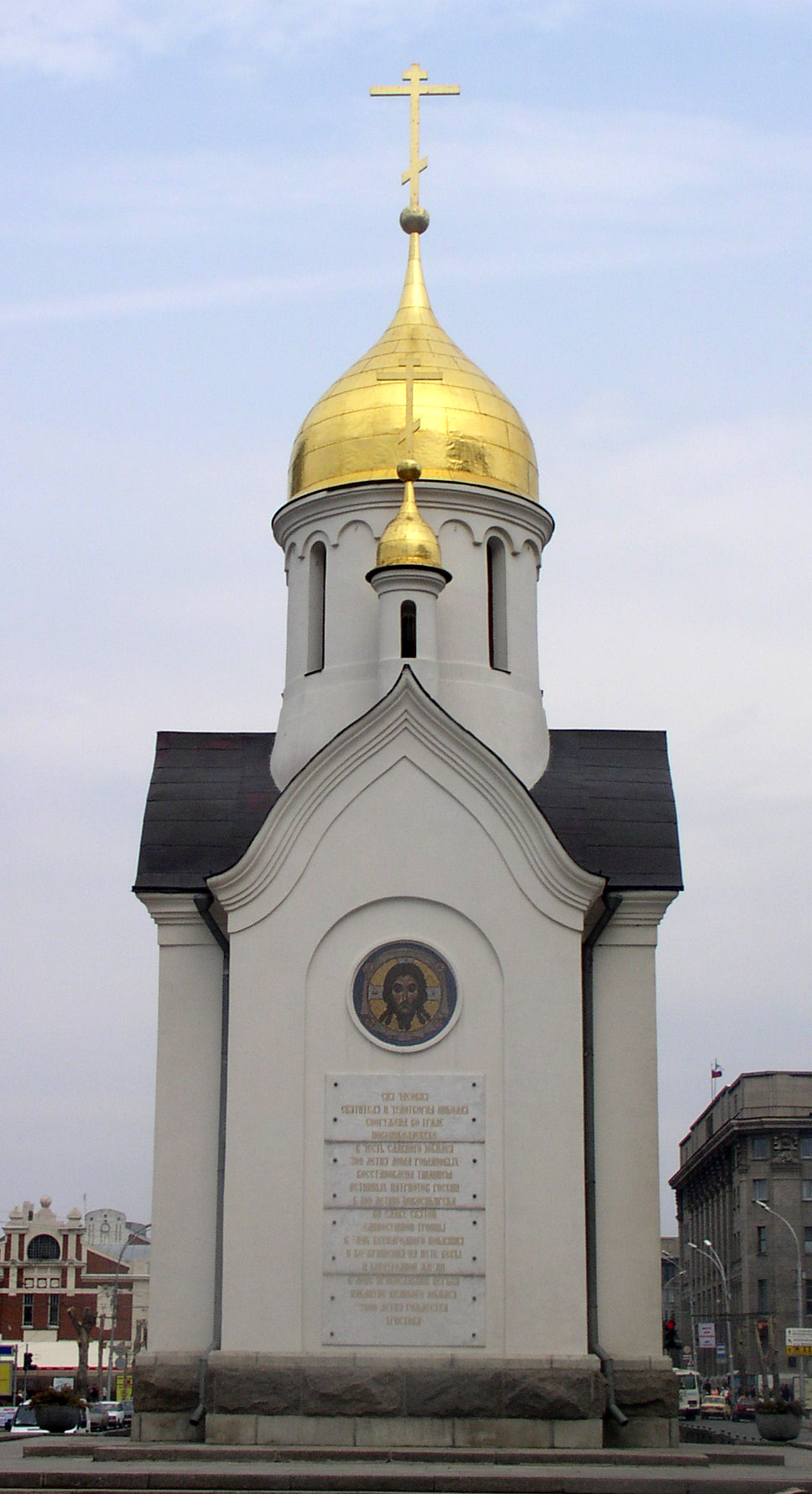
In Novosibirsk, the cathedral seat of the SELC and the location of Lutheran Theological Seminary, there is a small Russian Orthodox chapel, St. Nicholas, located on a main boulevard named for Lenin, on what is purported to be the exact geographical center of the old Russian empire.  The original chapel was destroyed by Stalin, but it was rebuilt after the fall of Communism - and is once again a Christian house of worship.  On the outside of this monument that represents Russia's center is an icon of our Lord Jesus Christ.  

This would have been unthinkable a little more than 20 years ago when the Soviet Union existed.  And in spite of Lutheranism being the second largest Christian confession in Russia before the Revolution, and having been there since the Reformation itself, it was virtually destroyed by the time of Stalin.  But thanks to faithful lay people who kept the faith alive in the Gulag and in exile, teaching their children to pray, squirreling away Bibles and catechisms, and reciting scripture from memory - the Lutheran Church outlived the Communist State.  Today there are pastors and churches - and there are a lot of children and young adults who are pioneers - not like the old red-scarfed Pioneer Movement for children being indoctrinated into Communism, but rather a new generation of free people, pioneers catechized into Christianity and Christian liberty in the gospel under the red of the blood of Christ.

We have the opportunity to take part in this ongoing miracle.  Please check out the SLMS and prayerfully consider helping our brothers and sisters bring the gospel to Russia!  If you have not seen the above video before, it is well worth a view.  It is an accurate and moving portrait of the Holy Spirit's work in Russia, especially through the ministry of the pastors in the lives of the faithful in the parishes, everywhere where the Word is preached and the sacraments are administered in faithfulness.  

Sunday, February 19, 2012

A Question Concerning Districts

"Pastors" of the Mekane Yesus Lutheran (sic) Church (sic) in Ethiopia
By Larry Beane

I've been a member of the synod since my ordination in 2004.  But I still do not understand our polity in the LCMS.  It is a mystery right up there with the riddle of the sphinx and the fate of Atlantis  - though with 18 years of marriage under my belt, I may finally be starting to understand the gentler sex.  However, the LCMS's bureaucratic machinations is something that I may never really grasp on this side of the grave.  And in eternity, I don't think we'll be too concerned with synodical bureaucracy - at least I hope not.  At any rate, I have a question: In the LCMS's structure, are the districts authorized to meet with the leaders of church bodies around the world that "ordain" women?

It sounds like a loaded question, but it really isn't.  I honestly don't understand what the district's role is in forging relationships with international Lutheranism.  I know that our seminaries - particularly my alma mater CTS-Fort Wayne - established contact with several Lutheran bodies around the world.  In some cases, this has paved the way to full altar and pulpit fellowship.  I know that these contacts have been criticized by some for not following political protocol.  I honestly don't understand all of this.  All I know is that there are faithful Lutherans around the world who are courageously standing firm on the Bible and the confessions, bearing the cross and the gospel, who refuse to go with the flow on homosexuality and women's "ordination" (which are actually two sides of the same coin).

One such example is the preacher at President Harrison's installation, Kenya's archbishop Walter Obare, the recipient of the 2006 Sabre of Boldness.  He heroically defied the mighty Lutheran (sic) World Federation by consecrating a faithful Swedish bishop who would not "ordain" women and cave to the homosexual agenda in the Church (sic) of Sweden.  Archbishop Obare has written eloquently, and has backed up his theology with courageous deeds, and has borne a heavy cross as a result.  His action freed faithful Lutherans in Sweden to once more have pastors - something denied them by their own wicked bishops for many years.

What puzzles me is the recent news from the Southern District.  Here is an excerpt from the Spirit of Southern newsletter (Jan/Feb 2012):
District and Concordia-Selma Presidents Travel to Ethiopia 
District President Kurtis Schultz, accompanied by Rev. Dr. Tilahun Mendedo, President of Concordia College – Selma, AL, embarked on January 5th for a 13 day trip to Ethiopia. The Southern District Board of Directors at its December, 2010, meeting adopted a resolution that the Southern District express its strong desire for greater mutual conversation, encouragement, and kingdom work between the Southern District and the Ethiopian Evangelical Church, Mekane Yesus. They are the largest and fastest growing Lutheran church body in the world.The pastors’ itinerary included meeting with the leadership of Mekane Yesus, as well as visiting congregations and historical places.

Also reported here in the Southern District's This Ministry That We Share newsletter (Jan/Feb 2012):

PRESIDENT SCHULTZ TRAVELS TO ETHIOPIA 
President Schultz traveled to Ethiopia on January 5th and returned to Slidell, LA, on January 17th. President Schultz traveled with the Rev. Dr. Tilahun Mendedo, President of Concordia College – Selma, AL. Their itinerary included meeting with the leadership of Mekane Yesus, visiting congregations and historical places.  
The Southern District Board of Directors at its December, 2010, meeting adopted a resolution that the Southern District express its strong desire for greater mutual conversation, encouragement, and kingdom work between the Southern District and the Ethiopian Evangelical Church Mekane Yesus.   They are the largest and fastest growing Lutheran church body in the world.  
Ethiopia is a country located in the Horn of Africa.   It is the second most populous nation in Africa with over 82 million inhabitants.  It is also the most landlocked nation in the world.

This is all well and good until you consider that this church (sic) body, Mekane Yesus, is not only in full communion with the ELCA and the LWF, but according to its own website, it is proud to "ordain" women.  This fact seemed to have been omitted from the Southern District reports above.  That fact seems to me to be more important than its status as the "largest and fastest growing Lutheran (sic) church (sic) body in the world."

Arianism was also a large and growing "church" body.  Today's Mormonism and Islam are also large and fast-growing religious bodies.  Why does size and rate of growth trump faithfulness to the Scriptures?

I know that there are church bodies around the world in which there are conservative factions heroically fighting against women's "ordination" in their own midst.  There is also the recent historical example of the Church of Latvia which managed to rollback and end the practice of women's "ordination" thanks to yet another faithful bishop. Of course, I believe we need to support churches and their leaders who are willing to stand for the Bible and the confessions - even against their own hierarchies who have gone to the dark side by adopting cultic "ordination" practices.

But at least according to Mekane Yesus's own website, they are not exactly trying to do away with the practice, but are rather quite encouraging of expanding it!  Maybe the leaders that the delegation from the Southern District met with are in opposition to this practice and are fighting to overturn it.  I hope so.  The articles are silent regarding the matter.

Back to my original question: Is this the role of the LCMS district in international contact and ecumenical dialogue?

I was always taught that the districts are synod's representatives in a given place.  So, is this meeting between the leaders of the Southern District and Mekane Yesus supposed to represent some kind of official synodical ecumenical contact?  And what does it mean that the Southern District's board of directors has resolved to express its "strong desire for greater mutual conversation, encouragement, and kingdom work between the Southern District and the Ethiopian Evangelical Church Mekane Yesus" with no mention of the "elephant in the parlor" of women's "ordination"?

Can we do "kingdom work" with a body that is boastful of a Satanic practice like female "ordination"?  Is an LCMS district considered to be representing the synod as a whole when its leadership meets with high-ranking officials in other church (sic) bodies?  As a member of the Southern District, I would have been a lot more comfortable if the news announcements made it clear that the LCMS is not in fellowship with Mekane Yesus and the fact that the latter practices ordination of a diabolical sort that the district obviously condemns as contrary to Scripture.  I would feel a lot more comfortable if the mission were to call Mekane Yesus to repentance and to support dissidents trying to overturn the practice.  I'm going to assume and state publicly that there is no doubt a reasonable explanation that precludes any member of synod from sinning here.  My reason for raising this issue is not to accuse, not to presume that anything sinful has occurred by any member of synod - but rather to understand where the district comes into play when it comes to international contacts.

Again, I am not being critical of my district president (far be it from me!).  But as a member of synod, I am posing the question to other members of synod how all of this works.  Is there any implied relationship being forged between the synod and this Ethiopian Lutheran (sic) body?  But I will certainly and unequivocally condemn the heresy of women's "ordination" - which is really a manifestation of the goddess-cult and nothing other than a recapitulation of Eve's sin in the Garden of Eden under the temptation of the Serpent ("Did God actually say...?").  I believe every LCMS pastor ought to be able to agree that women's "ordination" is Satanic.

My personal opinion is that we should honor and support Lutherans around the world who refuse to "ordain" women.  As the faithful bishop of another Lutheran body worded it to me in a private e-mail: "By ordination of women Satan wants to destroy the priesthood in the Christ's Church. And we must resist, we must defend the Church, as we promised during our own ordination."

Again, what is the role of the LCMS district when it comes to this kind of ecumenical dialogue?

Thursday, October 6, 2011

So, could I just...


By Larry Beane

I'm getting a lot of requests for baptisms lately.

But it's not necessarily good news.

Just today, I got a call from a guy who lives about an hour away and would like his children "christened" at Salem Lutheran Church  "Christened."  That's always the first clue.  He said the name of his home church quickly, and then explained that his parents live in the area and that it would be most convenient to "just do it there."  So, could I just do the baptism?

I slowed him down and found out that he belongs to a Presbyterian church.  I told him that we do have Presbyterian churches in the area and that it would be best to find out which one is in fellowship with his church.  He insisted that Salem Lutheran would be more convenient, and that Lutheran and Presbyterian is really the same thing anyway.  So, could I just do the baptism?

I explained to him that Lutherans and Presbyterians do have some fundamental differences.  I briefly explained, for example, the difference between our views on the Eucharist.  He said that he was christened a Catholic and had no problem with our view of the Sacrament.  So, could I just do the baptism?

I recommended that he find a church that believes the way he believes.  I asked him which denomination of Presbyterian his church belonged to.  He didn't know.  He explained that did not pick that church based on belief, but based on the fact that they are convenient and have a really good school.  Belief really isn't the issue.  So, could I just do the baptism?

I explained that if I were to baptize his children, they would be under my pastoral care.  They would be Lutherans.  He replied that this would be fine with him.  He would have no problem being a Lutheran.  He didn't know what Lutherans believe, but he was certain that he would be fine with it.  But he really likes to go to the Presbyterian church because it's so convenient. And they have a really good school.  So, could I just do the baptism?

I felt like I was stuck in one of those Rev. Hans Fiene Lutheran Satire cartoons complete with the monotone computer voices, circular reasoning, the astonished silent blinking pastor, and Offenbach's Can Can music.

So, could I just do the baptism?


Friday, November 19, 2010

The LCMS and Women's "Ordination"

By Larry Beane

One of the great things the LCMS has been doing over the last several years is forging international contact, and in some cases, agreements, with confessional Lutheran churches around the world.  Concordia Theological Seminary - Fort Wayne has been on the cutting edge in fostering struggling Lutherans the world over with the provision of theological education, as in the heroic and ambitious Russian Project (see "For the Life of the World," Dec 1997 article on page 10) led by Rev. Dr. Tim Quill.  In fact, we're finally seeing what appears to be the blossom of full altar and pulpit fellowship with the Siberian Evangelical Lutheran Church, as we have now declared doctrinal agreement with that church after many years of talks, often peppered with seemingly ridiculous bureaucratic dithering on the part of the previous LCMS leadership.

Those days appear to be over, and thankfully so!

When it comes to supporting churches around the world, the LCMS brings great strengths to the table: sound theological education, a rigorous confessional reputation, and money.  It is a great boon to be recognized and nurtured by the LCMS.  And as a result, we Americans are able to help traditional and confessional Lutheranism to spread and thrive around the world.  And as is always the case, our brothers and sisters the world over provide us with shining examples of faithfulness in distress, and courage under fire, that in turn serve to inspire and support the evangelical and catholic faith in other places as well.

One of the things we should have learned from all of these international contacts is just how dangerous and evil women's "ordination" is.  It is not simply an aberration, a speedbump to unity, bad practice, or something to be tolerated.  Rather, it is a Satanic cancer that has infected the Body of Christ and, as former Church of Sweden "pastor" Ulla Hindbeck argues, something that will "lead people directly to condemnation."

The current angst and uproar over the approval of homosexuality in many worldwide Lutheran bodies is traceable to the movement to "ordain" women.  Scandinavian Lutherans led the way in the late 1940s, with Sweden beginning to "ordain" its first women in 1960.  The mockery of traditional vocations regarding human sexuality went so far as explicit and blasphemous pornography depicting Jesus and the disciples as homosexuals being displayed in the Swedish Cathedral at Uppsala with the blessing of Archbishop K.G. Hammar - only 38 years after the first female "ordinations."

In every country where confessional Lutheranism has been persecuted from within, women's "ordination" is not only a common practice, but is the touchstone and the fountainhead.  For the hierarchy of the Church of Sweden, women's "ordination" is the doctrine upon which the church stands or falls.  Candidates for holy ministry must take communion from the hand of a priestess in order to prove fealty.  Since the repeal of the "conscience clause" in 1982, there have been restrictions against ordination and against pastoral promotion for opponents of women's "ordination."  The glass ceiling in such feminist-dominated church bodies applies only to male ministers who still believe in Holy Scripture.

The Scandinavian glass ceiling was at last broken in 2005, when Kenya's archbishop Walter Obare (Sabre of Boldness 2006) boldly consecrated Arne Olsson to be a Mission Province bishop for the persecuted faithful in captivity within the apostate Church of Sweden. Bishop Obare's support of Biblical Christianity in Sweden initiated a firestorm of controversy including this courageous exchange with the aforementioned Archbishop Hammar a year before Bishop Olsson's consecration.  Archbishop Obare's resistance has had felicitous results for the faith.  One of the consequences is that Finland likewise now has a Mission Province bishop and a route to priestly ordination for faithful candidates for ministry (for the first time in a decade) in defiance of a Mother Church that has come to resemble an ecclesiastically nightmarish version of an abusive "Mommie Dearest."

Even though the LCMS doesn't "ordain" women, there is a toleration for those who accept it, or even agitate for it.  And even among those who believe W"O" is wrong, there are many who accept its validity to some degree or another.  I wonder how many pastors and laypeople in the LCMS realize just how evil this deviant theology - which veers from both Scripture and ancient catholic tradition - truly is.

This is one reason I had written this objection two years ago to LCMS ties to the Evangelical Church of the Augsburg Confession in Slovakia.  Such arrangements are confusing, especially to young church workers, who are put into a situation that appears to be endorsement of female clerics.  One person read my blog and confessed to me that she had spent a year in Slovakia as a young "missionary" - sent by the LCMS - and that she took "communion" from a female "minister" the entire time, never having been informed that this was wrong.

This should not be.

I am greatly concerned that even within the conservative LCMS, there may be an underlying agenda to "normalize" the abomination of women "pastors" in Christian churches - or at very least, encourage us to see it as a minor evil.  And I am also concerned that such an agenda may take advantage of the goodwill of genuinely confessional pastors and faithful synodical officials when it comes to cooperation with sects that endorse the Satanic practice of female "ordination."

I'm concerned that we might be playing with fire here.

It is one reason I'm not personally comfortable with any cooperation with the ELCA - not even in matters like malaria prevention.  For no cause - no matter how genuine and noble - is worth the spiritual harm of exposing faithful LCMS pastors and laypeople to the specter of women wearing clerical collars and answering to "pastor."  We still have such cooperation in joint LCMS-ELCA schools, chaplaincy, the aforementioned malaria project, and Thrivent.  Membership in the latter includes a subscription to a magazine that shamelessly uses "Pastor" and "Rev." before the names of women and will show pictures of collared women without any hint that this is a diabolical ruse to confuse the faithful and to mock God's Word and the Incarnate One.

This is why I am concerned with the recent announcement of the LCMS signing a working agreement with the Silesian Evangelical Church of the Augsburg Confession, which claims to ordain women.  This is not altar and pulpit fellowship, but rather a call for the "two churches to have regular contact between the church leadership, the holding of theological lectures and convocations, and invitations to each other's theological presentations" as well as "cooperation in diakonal work."

I am really concerned about unintended consequences here.  How will this be interpreted?

Now, it may well be that the Silesian practice of W"O" is actually being mothballed, and it is going to take time to back out of it.  I hope this is the case.  This happened with the Latvian Evangelical Lutheran Church, with which the LCMS shares fellowship, and it was a rare example of putting the toothpaste of female "ordination" back into the tube.  While there are "pastors" emeriti (emeritae?) in Latvia who lack the biological necessities for ministry, they have all been removed from any active service in the church.  The Latvian archbishop and leadership is strongly biblical and confessional, and they did overcome the burden of W"O" imposed on them in their days as a Soviet Socialist Republic.

Perhaps this is the case with Silesia.  I would feel a lot more comfortable if our own church leadership would clarify this matter.  I am in no position to speak for the many heroic Lutherans around the world who are struggling to remain faithful and who are looking to the LCMS for leadership and support, but I am reasonably certain that the last thing they would want to see is an LCMS even appearing to "go wobbly" in the face of the feminist juggernaut of western culture.

I am certainly not arguing that our current administration is in any way sympathetic to women's "ordination."  Nothing could be more clear than our synodical leadership's thoughtful and articulate opposition.  My question is one of policy.  I am just wondering out loud if this is the right thing to do.  Perhaps it is, and I hope it is!  I would love to be able to support this arrangement, but for now, I'm afraid the jury is out.

We live in a messy, fallen world.  Perhaps such "working agreements" are the best way to move forward and to bolster our more conservative brothers and sisters.  But there is also the real possibility that this only serves to give less than a clear confession to the world regarding something as foundational as the office of the holy ministry.