Thursday, September 12, 2013

A Trinity 17 Sermon by Fr. Joshua Hayes

[Ed note: Gottesdienst (the print journal) readers were treated to four top-notch sermons in the current issue, including one by Fr. Joshua J. Hayes of St. John Lutheran Church in Kramer, Nebraska.  He had actually sent me two sermons, and I went with his Trinity 18 offering.  But I also really liked his Trinity 17 sermon as well, and so I asked his permission to publish it here at GO.  If you're not a subscriber, you missed three other sermons by Frs. William Weedon, Dave Juhl, and Jay Watson - along with columns by Frs. Burnell Eckardt, David Petersen, Mark Braden, and Karl Fabrizius; essays by Fr. Peter Berg and myself, as well as a hymn by Fr. Eckardt and Mrs. Kathryn Hill. +LB]


Trinity 17, October 16, 2011

Joshua J. Hayes, St. John Lutheran Church, Kramer, NE

St. Luke 19.41-48


Grace, Mercy, and Peace to you from God our Father, and from our Lord and Savior, Jesus Christ.

X In the name of Jesus. X

It was a setup from the beginning. Jesus was invited to a dinner party at the house of a leading Pharisee, but not to be their guest, but to be framed. What better way to get rid of a nuisance than to have him framed? And what better way to get rid of a religious nuisance than to trap him in his own religion. The trap was set, the bait carefully positioned, and our Lord walked right into it. The Pharisees were watching Jesus carefully, just waiting for him to spring their trap.

And what was this trap? In their cleverness and religiosity the Pharisees thought they had a good plan: Seat Jesus right in front of a poor guy suffering from dropsy—a nasty disease where your body holds too much water. Jesus, so they thought, would be stuck between a rock and a hard place. Either Jesus would heal the man and have compassion on him and thus do work on the Sabbath, or Jesus would keep the Sabbath but appear to be unmerciful and weak.

The Pharisees here are doubly despicable. It is as if they knew that Jesus would have compassion. They had come to know that that’s who Jesus is; that’s how he behaves. He is full of mercy and compassion. Knowing this, the Pharisees preyed upon Jesus’ mercy. Unlike the parable of the unjust steward who risks everything on his master’s mercy to improve not only his own situation, but also that of his neighbors and the reputation of his master, these Pharisees only seek to use our Lord’s mercy to trap and destroy him.

But not so fast. Before you start condemning these despicable Pharisees for the way they use Christ’s mercy against him, point your Pharisaic finger at yourself. You do the same thing. These Pharisees were always in the habit of setting Jesus up for failure. But we do the same thing. Only how much more despicable are we who bear the name not Pharisee but Christian!

We pit Christ against his word and seek to use his mercy as the excuse for our sin. “Since Christ is all merciful,” we think, “there’s no real harm in lusting after women on the internet or TV.” “Since Christ will always forgive me, there’s no real problem in neglecting his word. Going to church isn’t a good work that earns my salvation, so why worry about making it there every Sunday? My Jesus is loving and forgiving; I don’t need to actually try to amend my life and love my neighbor, spouse, and children more than myself.”

Repent. Pharisees don’t care about what Christ says or does. They only want to catch him so as to have an excuse not to listen to him; to get rid of him.

But Jesus will not be gotten rid of; not by you, and not by these Pharisees. He loves you too much to let your brush him off. He walks straight into the Pharisees’ pathetic trap and springs it on purpose. He says, “Is it lawful to heal on the Sabbath, or not?” The Pharisees are silent. Now Christ has put them in their own trap and they know not what to say. They cannot but condemn themselves. We cannot but condiment ourselves. But though it will cost him his life, Christ will not leave you sick in the dropsy of your sins, but will heal you even if it means letting the devil have his way with him.

This is what Jesus does. He does not run from danger, but meets it head on. He does not run from the cross, but goes willingly to his death. The cross was the trap which the death and the devil had laid, and Christ sprung it to set you free. He lays down his life when he wants, and he goes free when he wants. On Calvary Christ laid down his life to save yours. Here at this Pharisaic dinner party, Christ walks straight into their trap and right out on the other side. At the cross, Christ walked into the devil’s trap and let him win, but came out on the other side that first Easter morning. 

Beloved, we have not been called to bear the name Pharisee, but rather Christian. And Christians you are, for you have been put into Christ. He, the one whom heaven and earth cannot contain was willing to be contained in the Virgin’s womb for you. He, the one who knows all things and sees all things was willing to grow and be taught the word of his Father for you. He, the one who humbled himself to death, even the death of a cross to raise you back up to the Father. Jesus has humbled himself and exalted you.

And see how high, dear Christian, your Jesus has exalted you! Your status is higher than any celebrity, any movie star, president, prince, or politician. For you have been called be a regular diner at the table of the King of kings.

There was once a man who had a funny name. His name was Mephibosheth. But worse than the awkwardness of his name was its meaning: “disgrace comes from my mouth.” He was disgraced because he was the only survivor from the family of a deposed king named Saul. And worse, yet, he was lame in both feet.

Mephibosheth should have been killed on the spot. That’s what you do with pesky relatives of former kings. You don’t want them coming after your crown, so you dispose of them. But it just so happens that Mephibosheth, disgraced as he was, lived under the rule of a gracious king: king David. David wanted to have compassion and mercy on his enemy, and so he exalted lowly Mephibosheth and restored all Saul’s lands to him. And more than that—David invited Mephibosheth to eat always at his table. And when you eat at the king’s table, your status is secure.

And so we read in 2 Sam. 9 that Mephibosheth ate at the king’s table, just like one of the king’s sons.

Beloved, today the Son of David, Jesus Christ, king of all creation, invites you to eat as his table, like one of the king’s sons. For this is what you are: Sons and daughters of the king.

Don’t you see? It was a setup from the beginning. All that Christ has done he has done to bring you’re here—to be a guest at his table; that you may dine with the everlasting king and know that your status with him is secure.

                                                                                                                       
In the Name of the Father, and of the X Son, and of the Holy Spirit. Amen.


The peace of God, which passes all understanding, keep your hearts and minds in Christ Jesus.

Wednesday, September 4, 2013

Out of the Barn!

The horse has been out of the barn for a couple of weeks already, but actually, it's more like a team of horses.  Most of the copies of the Michaelmas issue of Gottesdienst were released in late August; and today, the rest went out. Our new printers take the spreadsheet we send them and then they send the issues out to individual subscribers.  Any subscriptions that have more than one copy in them, or that are out-of-country, went out today, from here.  It's still a bit of a horse race, however, because the individual issues get sent via media mail, which can be slower. What's odd is that some of our readers actually get  to see the finished product before some of the editors do.

And what's really odd, and sad, is that some people will never see the finished product because, well, they're not subscribers.  Yet.

Subscribe today.  $15 for a year; $25 for two years (domestic rates).  Click here.  Wanna see what's inside?  Have a look:

Friday, August 30, 2013

The Brady Bunch, the Book of Concord, and a Paternal Postscript


By Larry Beane

As addressed definitively by Father Curtis in a previous post, our Lord's words in Matt 23:9-10 are often used by Protestants to decry the "Roman Catholic" custom of calling their pastors "Father."  Fr. Curtis addressed the biblical passages that conflict with that peculiar minority view found in modern American Protestant Christianity that vociferously attacks the "Father" custom.

I offer the following as a sort of PS, as the issue keeps popping up like the proverbial Whack-A-Mole carnival game.  The argument hinges on the question of our Lord's context.  Is this passage to be interpreted literally ("this is my body") or figuratively ("if your right eye causes you to sin, gouge it out")?  An episode of The Brady Bunch revolved around this kind of thing when Greg, seeking to work around being grounded, parsed his parents' decree by invoking "exact words" - knowing full well what the intent was.  Let's just say that Greg's hermeneutic did not get him closer to truth and the dishonesty rather complicated matters.

Regarding the assumption that the "father" custom is "Roman Catholic, there is a gap between perception and reality.  For the ancient custom is not only practiced by Roman Catholics, but also by Eastern Orthodox Christians, many Anglicans worldwide, and numerous Lutherans in diverse countries around the world, and to a lesser extent, in the United States.  Moreover, it is also practiced by Protestants and Lutherans when they refer to Roman Catholic clergymen by the title "Father."  If our Lord's words are intended to be taken literally, a Protestant Christian should never refer to a Roman Catholic, Eastern Orthodox, Anglican, or Lutheran pastor as "Father" - for the Lord's "exact words" (thank you, Greg Brady!) are "call no man father."

The "calling" is contrary to our Lord's words as well as the "being called."

And the Lord says "call no man," which would include our earthly fathers, church fathers, founding fathers, step-fathers, city fathers, grandfathers, etc.  If the Lord is being literal here, we must come up with a different name for "Father's Day."  Or, to invoke Greg Brady yet again in another episode, maybe teenagers, in order to be consistent with the Lord's command, should amble to the breakfast table in their shades and address their parents as "Mike" and "Carol."  Let's just say the Brady parents did not approve of this innovative custom of protest, disrespectful of tradition and authority.

Some objectors to pastors being called "father" argue that the Lord's words "call no man father" does not apply to our bio-dads - only to our fathers in the spiritual sense, such as pastors.  In so doing, such people are arguing that the Lord's words are literal in some cases, but figurative in other cases; that "call" is literal while "no man" is figurative - at very least, in some cases, but not others.  They parse the metaphor to not include some fathers, but to include other fathers.  It's all very confusing.

Many pastors (as well as ordained men not serving as pastors) are also "instuctors" ("neither be called instructors" v. 10) - whether they are teachers at parochial schools, universities, or seminaries.  The title "instructor" (as the ESV renders καθηγητής) must include the many titles we have for instructors, such as "Professor" and "Doctor."  Yet I have yet to hear anyone offended by this common practice, refer to it as sinful, or interpret the Lord's words to be a literal prohibition against calling men, ordained or lay, "Doctor" or "Professor."

Thus the argument, hacked at haphazardly by Occam's razor, runs like this:
  • Calling your biological, well, um, father, by the names "Father," "Dad," Pop," "Papa," etc. is okay.  
  • Calling your doctor "Doctor" is okay.  
  • Calling your ordained professor "Reverend Doctor" is okay.  
  • Referring to the Bishop of Rome as "the Pope" (which is an Anglicized form of the Latin/Italian title "Papa") is okay.  
  • But calling your spiritual, um, father, "Father" is one of the few linguistic prohibitions ever given us by our blessed Lord.
Moreover, if it is sinful to apply the title "father" to religious leaders, then St. Stephen committed this sin against our Lord just before being stoned to death by the men he called "fathers" by means as spiritual address, not to mention the Holy Spirit's ill-conceived judgment in allowing this in the inspired Scriptures (Acts 7:2).

But what of our Lutheran confessions?  Surely, calling clergymen "Father," from the parish priest to the Pope (which again means "Father"), was a common practice at the time of the Reformation.  Lutherans based their doctrine and practice on scripture - which certainly includes Matt 23.  Luther did not shy away from making reforms in doctrine and practice that were contrary to our Lord's words.  In fact, he was himself referred to as "Father Martin" as an ordained priest in a monastic order.  One would expect that after the Reformation, his title suddenly became "Pastor Luther."  Even "Doctor" would have been discarded if Luther interpreted Matt 23:9-10 in such as way as to gainsay the use of the honorific "Reverend Father" among Christian clergy.

Well, let's see what the Lutheran Confessions say.

Matt 23:9-10 never appears in the Book of Concord.  Not once.

In fact, the Lutheran confessions do not accept this supposed dominical prohibition of the title "Father," but they actually make use of it.
  • In the subscriptions to the Smalcald Articles, one of the signatories, Brixius Northanus, refers to the Smalcald Articles as "the Articles of the Reverend Father Martin Luther" ("articulis reverendi Patris M. Lutheri") - SA 3:15:27.
  • In the subscriptions to the Treatise on the Power and Primacy of the Pope (the title of the treatise itself violates Matt 23:9-10 if our Lord is speaking literally), we find the signature of John Brentz, who makes a statement of assent to the articles with a reference to "Dr. John Bugenhgen, most revered Father in Christ" ("D. Iohannes Bugenhagi, Pater in Christo observandi") - Tr - Subscriptions.  In this case, the "offense" is doubled by using both "Father" and "Doctor" as titles of address.  "Doctor" as a title is spread liberally throughout the subscriptions.  If these were seen as inappropriate usages, one could not find a hint of support from the Book of Concord.
  • The Formula of Concord (Solid Declaration) includes this reference: "Therefore also our dear fathers and predecessors, as Lutheran and other pure teachers of the Augsburg Confession..." ("Derhalben auch unsere lieben Väter und Vorfahren, als Lutherus und andere reine Lehrer Augsburglicher Konfession..." / "Quare patres et pii maiores nostri, D. Lutherus et alii sinceri doctores Augustanae Confessionibus...") FC SD 7:58.  This passage uses both "fathers" and "teachers" in a way that those citing Matt 23:9-10 in a literal way ought to disapprove of.
  • Martin Luther is also referred to as "doctor" and "teacher" in the Solid Declaration: "Dr. Luther as the leading teacher of the Augsburg Confession..." ("D. Luthers, as die vornehmsten Lehrers der Augsburgischen Konfession" / "D. Lutheri ut primarii doctoris Augustanae Confessionis") FC SD 7:34.
  • And it goes without saying that the bishop of Rome is referred to as "the Pope" in the Book of Concord: more than 120 times!
So either the literal interpretation of Matt 23:9-10 is wrong or the Book of Concord is in error.

We are all - spiritual fathers and spiritual children alike - guilty of quite enough real sins that we really don't need to be condemned further, accused of sinning against made-made rules under the guise of innovative Protestant customs rooted in bad hermeneutics and in ignorance of what the Book of Concord contains and of what the Lutheran fathers confessed and practiced.

In the end, Greg Brady learned the foolishness of playing the "exact words" hermeneutical game when it suited his selfish ends to reinterpret an obvious meaning within an obvious context.  Some of our Lutheran brethren have not learned this lesson.  

An Interview with Healy Willan


Thank you to my father-in-law Martin Fonda for recording this on VHS and sending it to me. I was finally able to convert it and load it up on YouTube.

Monday, August 26, 2013

Can you imagine a church like this?


By Larry Beane

Can you imagine a Lutheran church that has avoided the pitfalls of lay-ministry and lady deacons, a church that retains Article XIV and does not have a hire//fire mentality regarding her pastors, a church in which a man generally serves five years as a deacon before being ordained to the pastoral ministry (with no fast-track path), a church grounded in doctrine and practice in the historic catholic faith as confessed and articulated in the Book of Concord? Can you imagine a church where not a single congregation uses individual shot glasses or grape juice, where not one parish has "contemporary" worship - no rock music, no praise bands, no dancing girls, and no chancel dramas?  Can you imagine a church in which every Sunday communion is universally practiced as long as there is an ordained pastor to preside?  Can you imagine a church with no CRM controversy, no power struggles pitting districts against pastors and congregations, with arguments settled by politics and bylaws?  Can you imagine a church with no district and synod conventions, and no running for political office?

It may sound like a pipe-dream to us in the LCMS - even though we fancy ourselves as the orthodox among the orthodox.

Of course, there is no perfect church because there are no perfect church members.  But there is confessional faithfulness according to scripture, the confessions, and the catholic tradition - and that is found in the Siberian Evangelical Lutheran Church (SELC).  They are a church that practices what we at Gottesdienst preach.  They are also a church in full altar and pulpit fellowship with the LCMS, whose ties to the SELC go back almost to the very fall of the Soviet Union.

And no, not every SELC pastor wears a chasuble (most can't afford them).  Very few congregations use incense (St. Andrew, the cathedral church in Novosibirsk may be the only one that does), and the SELC services are spoken rather than chanted.  But the Divine Services conducted in the SELC are Russian versions of the traditional Western Mass.  Pastors are not free to cut and paste the liturgy.  The most noticeable thing that strikes the visitor to a Siberian Lutheran church is the reverence.  There is no nonsense, no games, no gimmicks - and yet there is pure unbridled joy, as the younger parishioners have only recently discovered the treasure of the gospel and the older members recall vividly when they were persecuted, their families exiled, their pastors shot, and their churches razed.  They understand that what happens in a church is truly important.  

Fortunately, we do not share this experience of persecution and trial in America.  But unfortunately, our Christian culture is lukewarm, and many take their liberty to worship and the treasure we have in the Holy Things completely for granted.

The SELC has its share of challenges.  There are relatively few congregations strewn across some eight time zones.  Travel is expensive and time consuming.  Unlike his LCMS counterparts, Bishop Vsevolod Lytkin personally knows and provides pastoral care to every priest and deacon in the SELC.  He stays with them, eats with them, encourages them, baptizes their children, and preaches in their pulpits.  He confirms the youth of the congregation, and does not allow potshots to be taken at the pastors by antagonists.  He visits every congregation, and he is himself a pastor with an altar and a pulpit.

To provide for this kind of genuine churchly fellowship and biblical oversight over such a swath of territory is expensive.  Neither the church nor the bishop is wealthy.  He does not stay in swanky digs when he travels.  Unlike the Russian Orthodox bishops, he does not have luxury cars and drivers.  Likewise the SELC parish priests travel great distances by rail and by road (often hundreds of miles of mud and dirt) in order to visit remote preaching stations and bring the Holy Sacrament to small groups of the scattered holy remnant from the days of Stalin.  Every pastor and deacon in the SELC is bi-vocational.  The SELC clergyman is paid roughly the equivalent of about $400 a month.  His parishioners are often impoverished, and sometimes the only thing they can present as a thank offering takes the form of garden vegetables.

The churches are small, nearly all housed in purchased flats in apartment buildings - and yet they are all traditional and dignified in their simplicity.  They have altars, pulpits, and fonts.  The people kneel to receive the body and blood.  The vessels are not ornate, but appropriate and decorous.  There may be wood carvings or icons adorning the sacred space.  The liturgical action is reverent no matter the circumstances - even if it happens in a beauty salon as the Mass I attended in Chelyabinsk was.

And the fellowship exists outside of the worship itself: tea and snacks, convivial conversation and mutual support, friendship and a sense of genuine fraternal communion forged by generations of enforced Atheism and Communistic hatred against the Church.  When our brothers and sisters in the SELC recite the Nicene Creed, it is said against the backdrop of the history of Gulag camps and secret police.  There is no talk of "clergy domination" - real or imagined - by anyone.

Not only is the SELC a living example of how Lutheranism in practice can indeed look like the Lutheranism of the Book of Concord, the SELC navigates a difficult political and social sea dominated by complex government regulations and a society that often sees any expression of Christianity outside of Russian Orthodoxy to be heretical.  And still, people come to the SELC - from Orthodoxy, from Pentecostalism, from the Jehovah's Witnesses, from the Atheism that still lingers.  There are still pockets of Lutherans being discovered who have lacked pastors since the days of Stalin.  They all come for the gospel preached in its purity and the sacraments administered according to Christ's institution - for the forgiveness of sins, for eternal life in Christ.

The SELC stands like a lighthouse amid the storms of abortion and alcoholism; of crime and cronies and cynicism; of long cold winters, perennial poverty, and periods of literal and figurative darkness.  Yet the Church is always bright, for she is illuminated by Christ.  She does not have the luxury to play games or try to draw people into the services with fads and entertainment.  It is far too late in the day for such things.  Christ is returning for His remnant!

Part of the SELC's mission is also to us in the LCMS.  She extends hope to us that we can also look forward to a time when the things we confess are indeed the things we practice.  They have shown us that with God all things are possible.  They have overcome far more than we have, and the Lord has blessed them with faithfulness and steadfastness in the carrying out of our mutual Evangelical Catholic confession.  There is a great affection between many in the LCMS and the SELC, as the first wave of SELC pastors and professors - especially at the Lutheran Theological Seminary at Novosibirsk - were educated at Concordia Theological Seminary - Fort Wayne under the auspices of the Russian Project.  They learned their confessional faithfulness from confessionally-faithful professors - and they have put it in practice in confessionally-faithful congregations.  We now have them as examples of confessionally-faithful pastors and lay people.

I urge you to get to know Bishop Vsevolod and the clergy and the laity of the SELC!  Many of them are on facebook.  Some of them speak English quite well.  And even those who don't speak English still communicate with us through Google Translate.  It means a great deal to them knowing that they have brothers and sisters on the other side of the planet who know they exist, who pray for them, who love them, and who confess that we are all one body.  For when one of them hurts, we all hurt.  When one wins the victory in Christ, we are all more than conquerors.  Individuals and congregations can sponsor a congregation and can earmark donations for the people that they can actually get to know thanks to technology such as facebook and Skype.

The Siberian Lutheran Mission Society (SLMS) is made up of mostly American Lutherans who are supporting our Siberian brethren in prayers and in offerings.  Over the years, the SLMS has made it possible for many church flats to be purchased, for evangelism to be funded, to support the travel of pastors to remote regions, and to provide for ongoing catechesis of lay people - including camps for children.  The SLMS has a unique policy concerning donations: 100% of gifts are wired to Russia.  All "overhead" is paid for by separate private donors.  You really can help in very real and tangible ways!

I would urge every Gottesdienst and Gottesdienst Online reader to check the website!  The newsletters - available online back to 2003 - are written by Russian pastors and laypeople, and they give an accurate and moving account of Christian life in the former Soviet Union, of the triumph of the Church of Jesus Christ over the spite and abuse of the commissars and party apparatchiks and relentless social pressure.  This is intense, captivating, and joyful reading.  They were also so kind as to link to my travelblog from 2011.  Several of the editors at Gottesdienst have been to Russia (some several times) to lecture in a variety of settings, teaching pastors, seminarians, and lay people the Christian faith and pastoral wisdom.  I would also point you to the Rev. Prof. Alan Ludwig's website and blog; Fr. Alan has been teaching at Novosibirsk since 1998.  His writing is fascinating and utterly inspiring.  

In spite of their poverty, social and political challenges, vast distances and harsh climate, small numbers, and a hostile culture, our brothers and sisters keep the faith day in and day out.  

LCMS pastor Fr. Daniel Johnson, who served a congregation in Iowa for nearly 20 years, who has traveled almost annually to Siberia for some 14 years, and who is the immediate past president of the SLMS, is now the LCMS mission catechist to Eurasia.  He is in Siberia right now.  Unfortunately, his new position makes it harder for him to raise funds and support the SLMS and the SELC on the homefront.  He reports that SLMS funds are extremely low right now.

If you would like to support a Gottesdienst-friendly mission outreach, genuine Lutheranism and an outpouring of the Holy Gospel to people in need of its joy and freedom, without the nonsense that too often accompanies missionary endeavors, please contact the SLMS and find out how you can sponsor a congregation - even if it is with a small amount.  They really need ongoing support.  One day, Russian missionaries may need to come to America and teach Miley Cyrus's grandchildren who Jesus is and how to recite the catechism.  One day, beneficiaries of our mission gifts to Russia may come back to us as our own people may emerge from persecution in need of instruction and faithful Lutheran doctrine and practice.

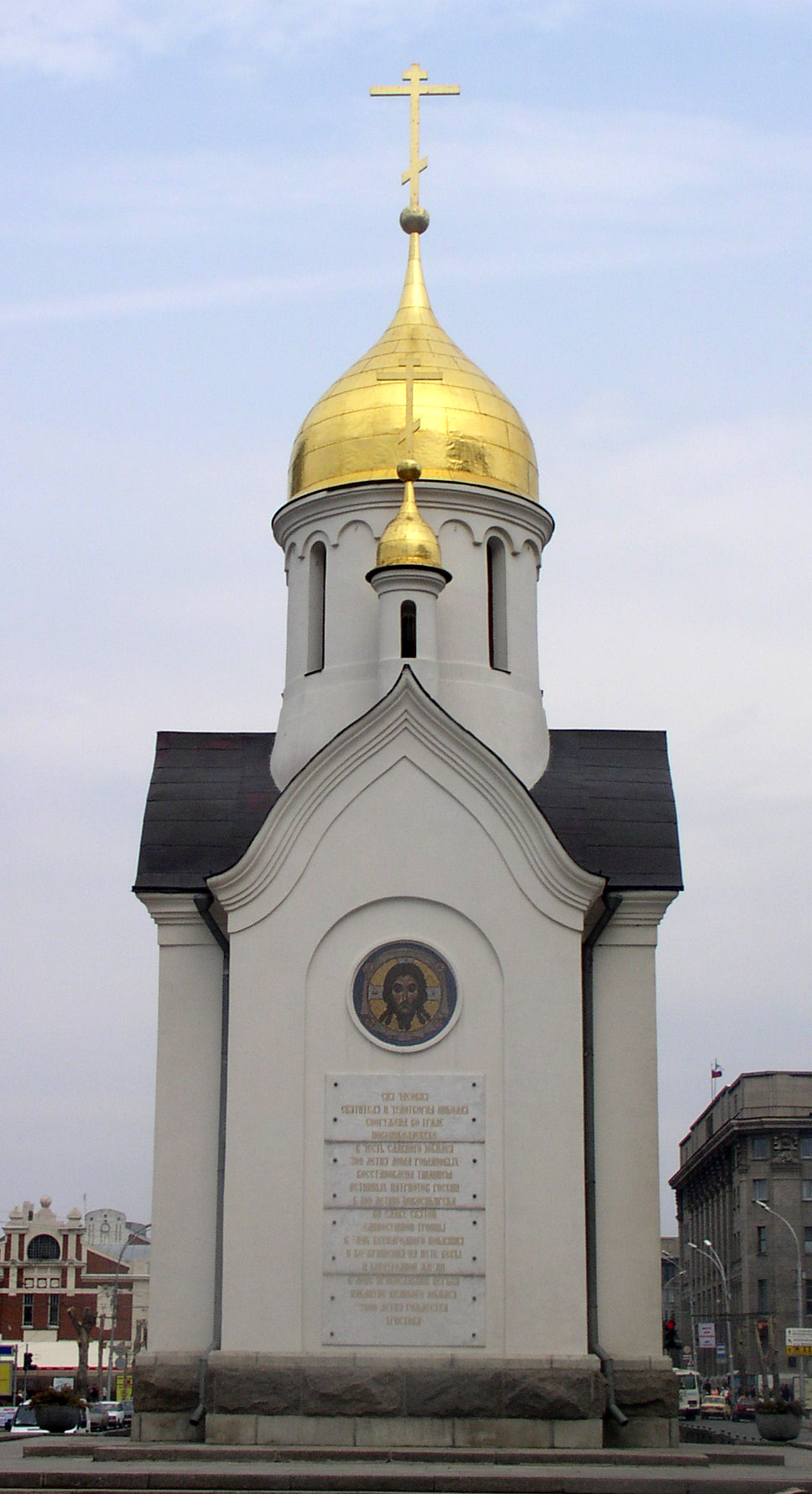
In Novosibirsk, the cathedral seat of the SELC and the location of Lutheran Theological Seminary, there is a small Russian Orthodox chapel, St. Nicholas, located on a main boulevard named for Lenin, on what is purported to be the exact geographical center of the old Russian empire.  The original chapel was destroyed by Stalin, but it was rebuilt after the fall of Communism - and is once again a Christian house of worship.  On the outside of this monument that represents Russia's center is an icon of our Lord Jesus Christ.  

This would have been unthinkable a little more than 20 years ago when the Soviet Union existed.  And in spite of Lutheranism being the second largest Christian confession in Russia before the Revolution, and having been there since the Reformation itself, it was virtually destroyed by the time of Stalin.  But thanks to faithful lay people who kept the faith alive in the Gulag and in exile, teaching their children to pray, squirreling away Bibles and catechisms, and reciting scripture from memory - the Lutheran Church outlived the Communist State.  Today there are pastors and churches - and there are a lot of children and young adults who are pioneers - not like the old red-scarfed Pioneer Movement for children being indoctrinated into Communism, but rather a new generation of free people, pioneers catechized into Christianity and Christian liberty in the gospel under the red of the blood of Christ.

We have the opportunity to take part in this ongoing miracle.  Please check out the SLMS and prayerfully consider helping our brothers and sisters bring the gospel to Russia!  If you have not seen the above video before, it is well worth a view.  It is an accurate and moving portrait of the Holy Spirit's work in Russia, especially through the ministry of the pastors in the lives of the faithful in the parishes, everywhere where the Word is preached and the sacraments are administered in faithfulness.